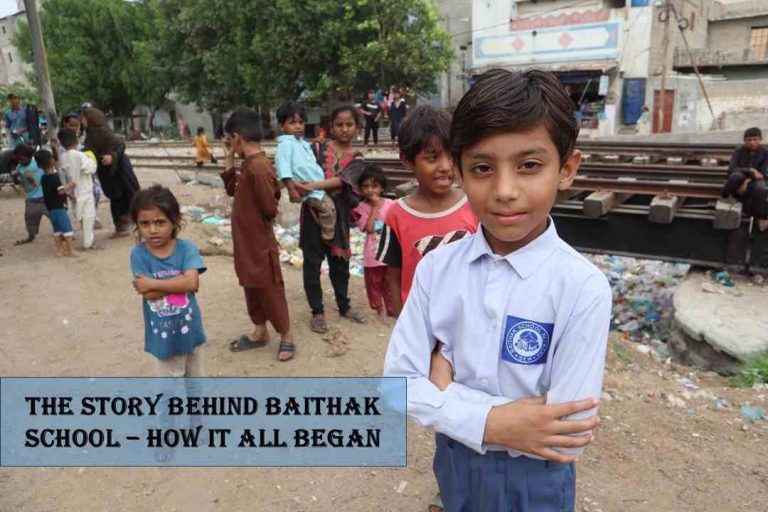
In the mid-1990s, a small group of women in Karachi noticed something that would change their lives, and thousands of others. Every morning, they saw children loitering on the streets, playing barefoot, or helping their parents earn a living, while other children went to school with bags on their shoulders. That heartbreaking contrast became the seed for what would later become Baithak School, a pioneering movement for free education in Pakistan.
Baithak School began with one simple belief: every child deserves access to free, quality education, no matter where they are born. The founders, under the Society for Educational Welfare (SEW), didn’t start with fancy buildings or big donations. What they had was purpose and compassion. The first “Baithak”, meaning a small sitting area, was exactly that: a simple room, mats on the floor, and a handful of children eager to learn. It was the beginning of an inspiring journey toward education for underprivileged children.
From that modest start in 1996, Baithak School Network has grown into a system of more than 140 free schools across Pakistan, serving over 18,000 students in slums, rural villages, and urban settlements. These schools provide free education, books, and a nurturing environment, giving children from low-income families a real chance to break the cycle of poverty.
One of Baithak’s strongest pillars is women empowerment through education. Most of its teachers are local women, mothers, daughters, and sisters who are trained and supported to become professional educators. Their presence builds trust with parents and motivates more girls to attend school. Through regular teacher training programs, Baithak ensures that education remains both accessible and high in quality.
The organization’s mission goes far beyond academics. Baithak Schools teach discipline, hygiene, values, and community awareness, empowering students to become responsible citizens. These lessons ripple outward and inspire and uplist families and entire neighborhoods.
Of course, challenges remain: securing funds, improving infrastructure, and reaching remote communities are ongoing struggles. Yet, Baithak continues to thrive, driven by the unwavering belief that free education can transform lives.
Today, when you step into a Baithak classroom, you’ll see children learning joyfully, teachers guiding passionately, and futures being shaped with hope.
Baithak School is more than a network of free schools, it’s a movement for equality, dignity, and opportunity. It proves that small beginnings, rooted in compassion, can lead to extraordinary change.